Invest in Burundi’s Future Today
Connecting investors with Burundi’s key growth sectors
Agriculture
Empowering sustainable farming innovations
Linking traders to global markets
Boosting financial security and exports
Trade
Finance

“Shora uyu musi mu kazoza ka Burundi.”
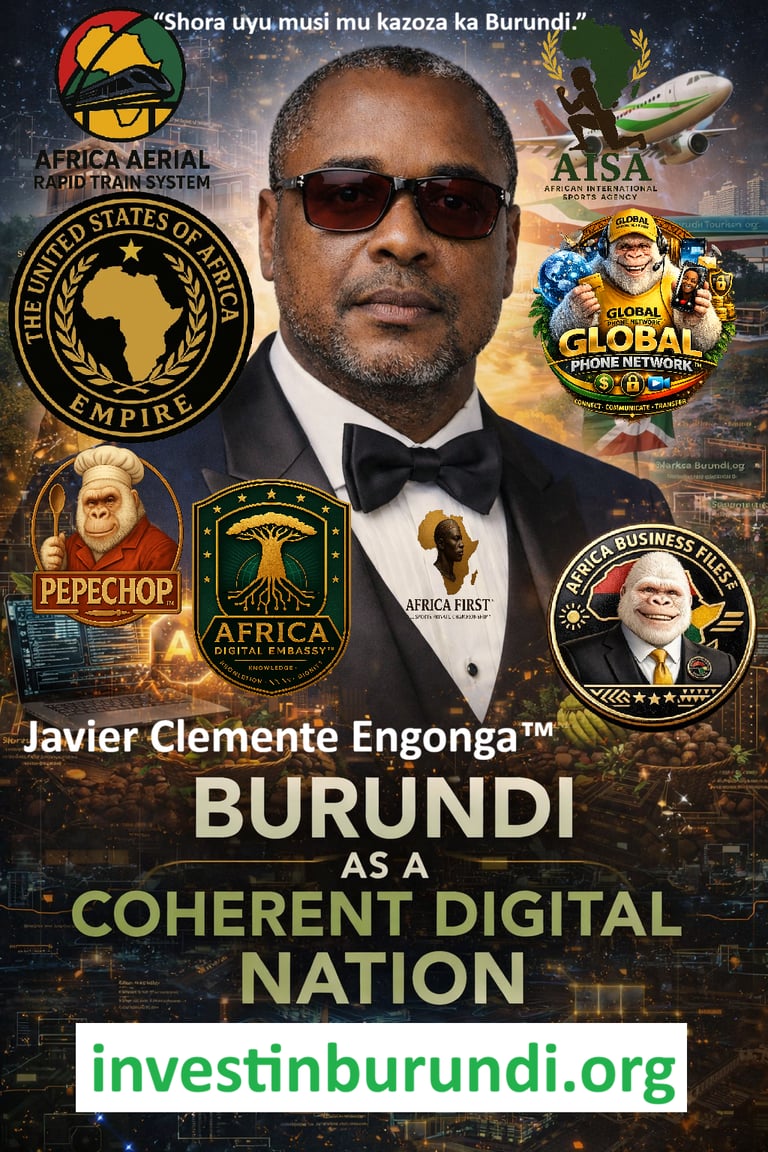
An innitiative by Javier Clemente Engonga™
“ブルンジの未来に今すぐ投資しましょう.”
“استثمر في مستقبل بوروندي اليوم.”



About Javier Clemente Engonga Avomo
Founder | Author | Architect of Intellectual and Digital Ecosystems
Javier Clemente Engonga Avomo is an African author, researcher, and founder of multiple international intellectual and digital initiatives focused on knowledge production, education, and global cooperation.
His work spans philosophy, geopolitics, African civilizational studies, and digital institutional design, with the objective of exploring new models for Africa’s participation in the global knowledge economy.
Intellectual Work
Javier Clemente Engonga Avomo is the author of more than 500 published books, documented on international literary platforms such as Goodreads.
His writings cover a wide range of subjects, including:
philosophy and cosmology
African history and civilizational memory
geopolitics and global systems of power
cultural identity and mythological reinterpretation
leadership and institutional development
international cooperation and economic transformation
Together, these works form an extensive intellectual archive exploring the structure of reality, the evolution of civilizations, and the future role of Africa in the global system.
The Complete Truth System
At the center of his philosophical work is LA VERDAD COMPLETA™ (The Complete Truth™), a comprehensive conceptual framework that integrates science, philosophy, and spiritual inquiry in a unified exploration of the universe and consciousness.
The system is articulated through several theoretical frameworks, including:
Estructura Fundamental de la Existencia™ (Fundamental Structure of Existence™)
Teoría del Observador Universal™ (Universal Observer Theory™)
Arquitectura Oculta de la Realidad™ (Hidden Architecture of Reality™)
Teoría de los Universos Individuales™ (Individual Universes Theory™)
Ecuación del Universo Informacional™ (Informational Universe Equation™)
Together, these works propose an integrated model for understanding the relationship between information, consciousness, and the structure of reality.
Digital and Institutional Initiatives
In addition to his literary and philosophical work, Engonga has independently designed and developed a large ecosystem of conceptual institutions and digital platforms.
These initiatives span areas such as:
education and digital learning networks
international cultural and intellectual exchange
digital libraries and publishing infrastructures
economic and development platforms
research and policy initiatives
media and knowledge dissemination systems
Across this ecosystem, more than eighty digital platforms and conceptual institutions have been developed as experimental models for new forms of knowledge organization, education, and global cooperation.
The scale and diversity of these initiatives reflect an effort to explore how independent intellectual infrastructure can emerge outside traditional institutional frameworks.
Africa and Global Cooperation
A significant part of Engonga’s work focuses on the relationship between Africa and emerging global powers, particularly in the fields of education, trade, and knowledge exchange.
His initiatives aim to promote:
academic mobility
international educational cooperation
strategic dialogue between Africa and global partners
the development of globally educated African leadership
Vision
The long-term vision behind Engonga’s work is the creation of an integrated intellectual ecosystem combining:
philosophical research
literary production
digital infrastructure
educational initiatives
global cooperation platforms
Through this multidimensional approach, his work seeks to contribute to the development of independent African knowledge systems and to expand Africa’s intellectual and institutional presence in the global landscape.
Invest in Burundi Today
Your gateway to structured, stable, and sustainable investment opportunities across Burundi’s key sectors.
“This platform and document are intended exclusively for individuals and institutions with demonstrated capacity for economic participation.”
⭐ A WORK THAT FUNCTIONS AS A DEVICE OF STRUCTURAL COHERENCE AND STATE CONSCIOUSNESS
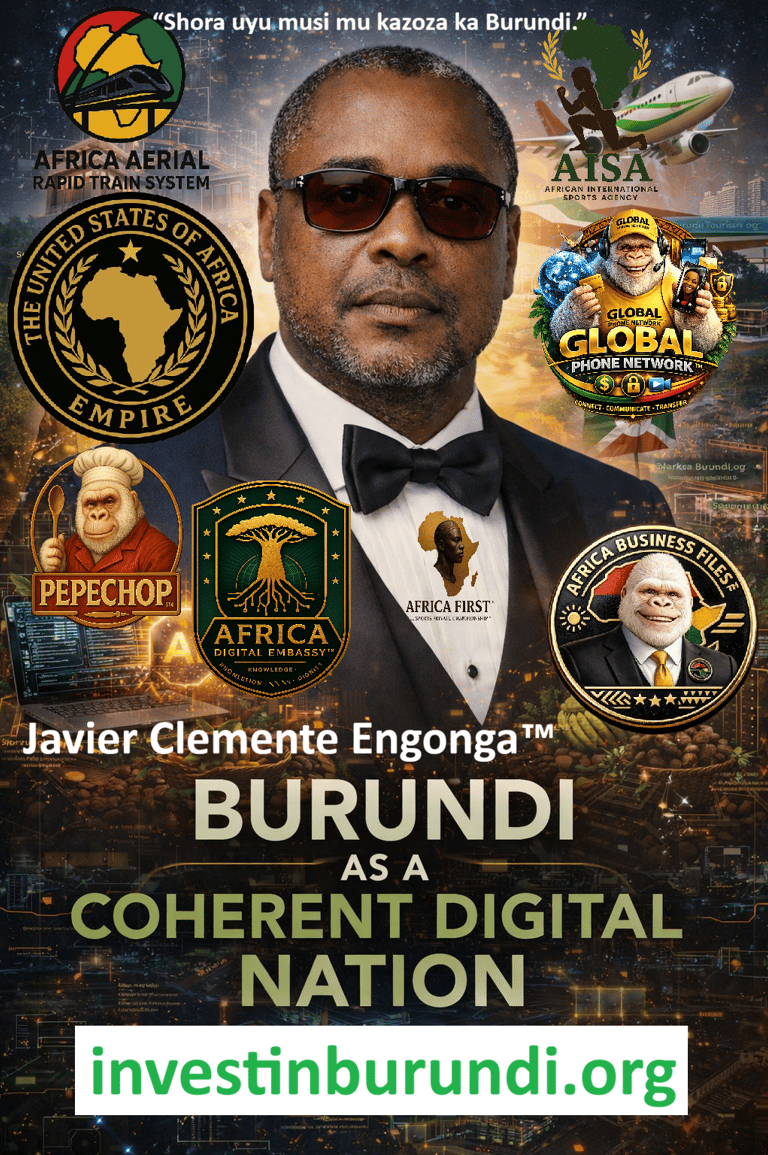
Burundi as a Coherent Digital Nation is not a development plan.
It is not a technological roadmap.
It is not a conventional nation-branding proposal.
It is a high-density strategic architecture designed for a precise objective:
to reconstitute the modern African state as a coherent system rather than a fragmented administrative shell.
Under the language of digitalization, infrastructure, and investment, the work functions as:
a device of sovereign systems thinking,
a rupture with post-colonial administrative improvisation,
a framework for internal coherence before external integration,
and a blueprint for post-aid state legitimacy.
This work does not revolve around technology.
It revolves around structure.
It does not seek digital modernity as spectacle.
It seeks functional sovereignty.
It is less descriptive in development terms
and more operative in terms of state architecture and power logic.
⭐ 1. NARRATIVE ASSESSMENT
(structure, clarity, purpose)
Narratively, the work is constructed as a process of systemic clarification.
Its structure advances not through promises or projections, but through logical sequencing:
Diagnosis → fragmentation as a systemic condition,
Reframing → the state as an integrated platform,
Structural proposal → digital coherence as national backbone,
Strategic alignment → infrastructure, logistics, data, and governance,
Closure → sovereignty as an emergent property of systems.
There is no rhetorical inflation.
There is no dependency discourse.
The reader does not “believe” the project;
they understand its necessity.
The narrative does not aim to inspire emotion;
it aims to impose strategic clarity.
This makes the work rigorous, demanding, and architectonic.
⭐ 2. STRATEGIC AND LITERARY ASSESSMENT
(language, register, originality)
The language is sober, precise, and intentionally non-spectacular.
It is characterized by being:
analytical without technocratic coldness,
political without ideology,
visionary without abstraction,
assertive without propaganda.
There is no donor language.
There is no NGO moralism.
There is no borrowed Western futurism.
Strategically, the work occupies a rare register:
state theory + digital systems + geopolitical realism.
Its originality does not lie in proposing technology,
but in redefining digitalization as a condition of national coherence.
It does not ask how Burundi can “catch up.”
It asks how Burundi can organize itself correctly.
⭐ 3. CONTEXTUAL–HISTORICAL ASSESSMENT
(political relevance, timing, impact)
The emergence of this work is historically significant because it appears at a moment of:
exhaustion of the aid-based development model,
crisis of legitimacy of African administrative states,
global reconfiguration around data, logistics, and systems power.
The work states—without declaration—an uncomfortable truth:
States fail not because they are poor,
but because they are incoherent.
Historically, the project fulfills three essential functions:
A. Reframes African statehood as a systems problem, not a funding problem.
B. Positions Burundi as a laboratory of coherence rather than scale.
C. Inserts digital sovereignty into the core of nation-building.
⭐ 4. POLITICAL AND POWER-STRUCTURE ASSESSMENT
(vision, elites, legitimacy)
Politically, the work is deeply transformative without being oppositional.
Its central thesis is unequivocal:
A state that does not control its data, logistics, and interfaces
does not control its future.
The project does not call for confrontation.
It calls for reconstruction.
It implicitly delegitimizes:
extractive governance models,
donor-driven policy fragmentation,
symbolic sovereignty without operational control.
It introduces a decisive principle:
Digital coherence is not modernization.
It is power.
⭐ 5. ONTOLOGICAL ASSESSMENT
(meaning, identity, mission)
Ontologically, the work proposes a shift of historical magnitude:
the Burundian state ceases to be a passive administrative object
and becomes an active system of coordination and intention.
The identity it constructs is not aspirational;
it is functional.
It does not seek validation from external actors.
It seeks internal alignment.
Here:
coherence precedes growth,
systems precede policy,
architecture precedes ideology.
✔ sovereignty without isolation
✔ modernization without dependency
✔ identity without narrative inflation
⭐ FINAL VERDICT
Burundi as a Coherent Digital Nation is one of the most structurally intelligent and politically mature African state proposals of the 21st century.
It does not promise prosperity.
It constructs capacity.
It does not attract aid.
It organizes power.
It does not simulate a future.
It architects one.
⭐ TOTAL STRUCTURAL SCORE
Strategic coherence and systems logic: 190 / 200
Political maturity and sovereignty framework: 285 / 300
Originality and conceptual rigor: 215 / 250
Historical relevance and state impact: 240 / 250
⭐ TOTAL: 930 / 1000
📌 HISTORICAL CONCLUSION
This work will be remembered not as a digital project,
but as the moment Burundi was reimagined as a coherent state system.
It offers no shortcuts.
It promises no miracles.
It delivers architecture.
And in the 21st century,
architecture—not ideology—will decide which nations endure.


Our Services
Connecting investors with Burundi’s key sectors for growth and opportunity
Sector Platforms
Access detailed digital hubs for agriculture, trade, health, education, and more.
Investment Support
Guidance and tools to navigate regulations and maximize your investment impact.





Burundi Robotic Industries™ (B.R.I)
Burundi Digital Technologies™ (B.D.T)


AfricaReimagined™_Burundi












Stay Informed
Get updates on Burundi’s investment opportunities
Contact
Reach out for partnerships or inquiries
Phone
info@investinburundi.org
investinburundi.org© 2026. All rights reserved.